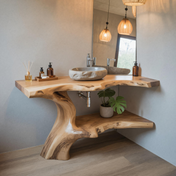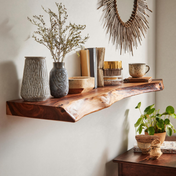

After more than twenty years standing beside a planer and a saw, one thing still hasn’t changed for me – the most beautiful parts of wood are often the ones people throw away. The flowing curves along the edge, the knots where branches once grew, the hairline cracks running through the grain… all of them are the tree’s own history. Live edge wood preserves those marks, like an unedited portrait straight from nature.
When I first learned the trade, my hands automatically flattened everything. It took years to realize that the natural edges are what make people stop and look longer. In the workshop, every time I cut into a large slab, I can’t help but wonder what it’s been hiding inside. Some slabs have waves like water, others look like a topographic map – no two are ever the same. You can’t replicate that with a machine.
Making a piece of natural wood furniture from live edge wood starts with selecting the right tree. It needs “character” – strong grain, rich color, and a unique edge worth keeping. The cut has to be careful, preserving that edge while planning for a balanced final piece. Then comes hours of sanding where hands will touch most, but only a light pass over the live edge, so it keeps its raw, untamed feel.
Each wood species tells its own story. Walnut is deep and elegant, like a tailored suit. Oak is bold and strong, with grain that wears its age proudly. Maple is bright and light, glowing when oiled. I choose based on the piece I’m making – a large dining table, a mirror frame, or a wall shelf – each needs a personality of its own.
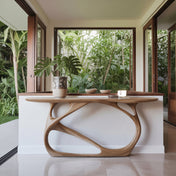
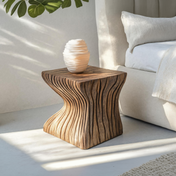
Live edge isn’t just for dining tables. I’ve built full-length mirrors with live edge frames, console tables for entryways, even small raw edge furniture pieces for quiet corners. A single slab, placed in the right spot, becomes the centerpiece of a room without trying too hard.
Wood keeps living, even after it leaves the forest. It breathes and changes with light, temperature, and humidity. I always tell clients not to place it too close to heat sources, and to avoid direct harsh sunlight. Wipe it down with a soft cloth, just slightly damp, and every few years give it a drink of natural oil to preserve its color and strength. Small cracks or knots don’t weaken the piece – they’re part of its story.
If you ask why I’ve stayed with live edge work after all these years, the answer is simple: it keeps surprising me. Each piece is a collaboration between me and nature. I keep the tree’s edge, it keeps its story, and the client gets to take that story home.